Are the Tests of Today Actually the Foundation Assessments of Tomorrow?
How AI could reshape what we assess, the level of capability we expect, and the boundary between human and human–AI performance.
How AI could reshape what we assess, the level of capability we expect, and the boundary between human and human–AI performance.
Much of the conversation about AI and assessment has understandably focused on threat. Can we still trust unsupervised assessment? How do we know whose work we are looking at? Can online proctoring still provide sufficient assurance? Do we need different security controls?
These are important questions, but I increasingly wonder whether they are only part of the question. AI is not simply changing how people might circumvent an assessment. It is changing what people can reasonably be expected to achieve, and if AI changes human capability, then eventually it must change assessment too.
One of the themes emerging from recent assessment discussions, including those at the IAEA conference, is the need to distinguish between two different forms of evidence. There are situations where we need credible evidence of what someone knows and can do without AI, and there are situations where the capability we actually care about is what someone can achieve with AI.
That distinction sounds straightforward, but its consequences are significant. For most of the history of formal assessment, the capability of the person and the capability being assessed have broadly been treated as the same thing. We test what you know. We test what you can calculate. We test what you can write, diagnose, analyse or decide.
Technology has always complicated that relationship. Calculators, search engines, spellcheckers, specialist software and access to information have all shifted what we expect people to remember or perform themselves. AI potentially changes the scale of that shift because we are beginning to augment human cognitive capability itself.
That leads me to the question I keep coming back to:
Are the tests of today actually the foundation assessments of tomorrow?
Perhaps many existing assessments are not becoming obsolete. Perhaps they establish something that may become increasingly important: the baseline knowledge, understanding, judgement and capability that resides within the individual.
That becomes the foundation level.
Then comes another layer. What can that same person achieve when augmented by AI?
That potentially becomes a much more advanced assessment of capability, and I do not think that assessment should necessarily be easier. If someone has access to an extraordinarily capable AI system, our expectation of what they can accomplish should arguably increase. The bar moves.
So instead of thinking only about how AI affects existing assessment, perhaps we also need to think about how it changes the level of human performance we expect to assess.
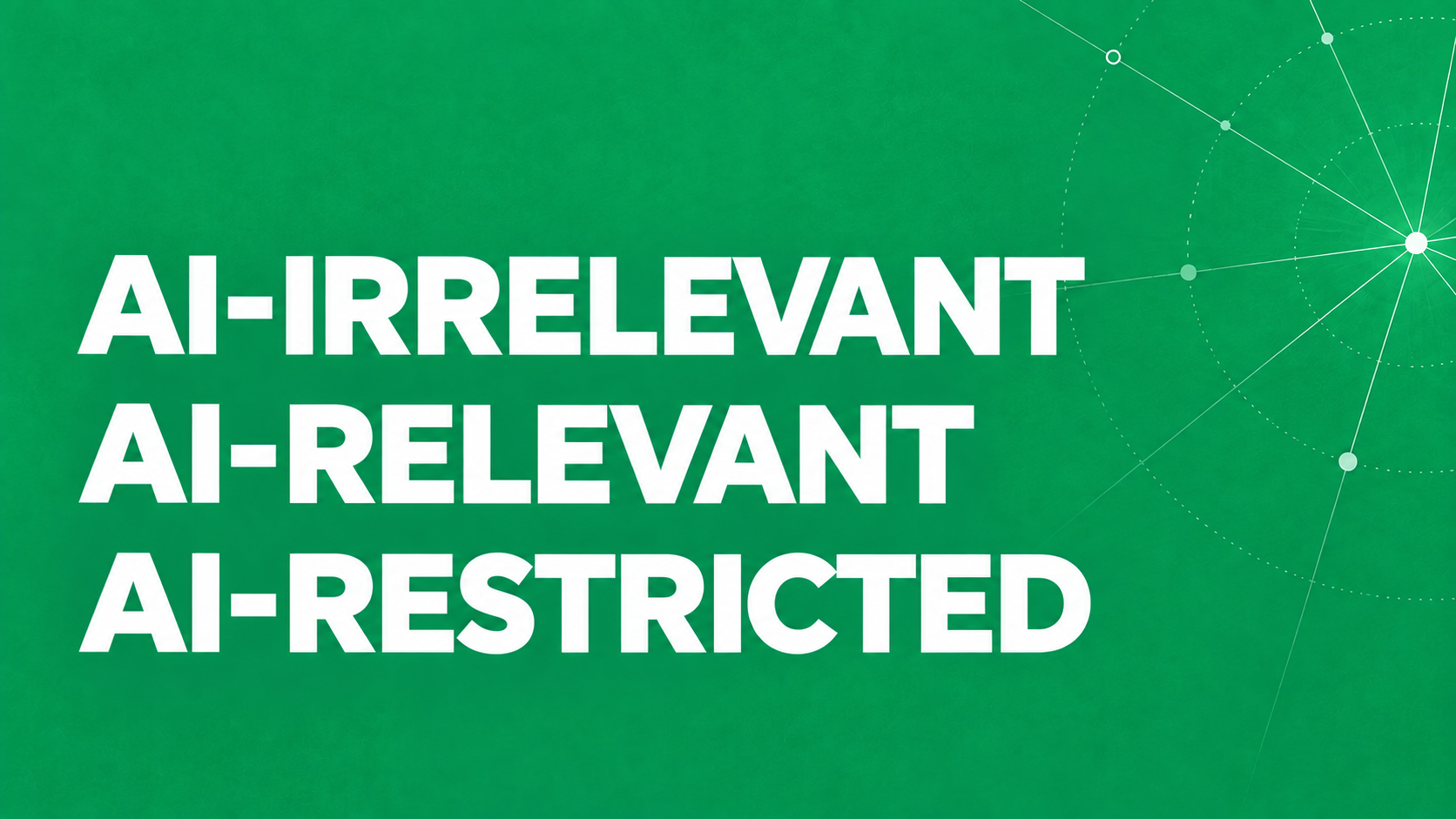
When I think about what that future assessment landscape might look like, I keep returning to three broad categories.
AI-irrelevant is where it does not matter whether AI is used because its use does not materially undermine the evidence the assessment is intended to provide. The task is designed in such a way that access to AI does not invalidate the conclusion we want to draw about the candidate.
AI-relevant is where AI is deliberately part of the activity because effective human–AI working is itself part of the capability being assessed. This is very different from simply saying that candidates are “allowed to use AI”. The use of AI is part of the construct.
AI-restricted is where we specifically need evidence of what the individual knows or can do unaided. AI therefore has to be excluded or sufficiently controlled. This is where assessment security becomes particularly important because, if the claim we want to make is that this person can perform this activity themselves, then the delivery environment has to support that inference.
These categories are not intended as another set of rules about which tools are allowed and which are prohibited. Technology will change too quickly for that. They are intended to describe the relationship between AI and the capability we are trying to evidence.
The AI-relevant category is where I think we need much more nuance.
We increasingly hear terms such as AI literacy or the ability to use AI effectively, but there is an enormous difference between using an AI assistant and taking responsibility for work performed by increasingly autonomous AI systems.
I currently think of this as four levels.
AI Assisted — Hands-on. The person is actively doing the work and using AI to support them. The question is whether they can make effective use of AI while continuing to contribute their own professional knowledge, judgement and value.
AI Controlled — Hands-off. AI is doing more of the production, while the human shifts towards interrogation and review. Can they identify errors, spot weak assumptions, challenge the output and correct it when necessary?
AI Managed — Eyes-off. The person is no longer examining every individual action or output. They are overseeing AI activity. Can they establish appropriate controls, monitor performance and recognise when intervention is required?
AI Delegated — Brain-off. Increasingly capable agents make it possible to delegate complete activities rather than individual tasks. At this point, the human capability changes again. Can the person decide what can safely be delegated, understand the consequences, recognise when something has gone wrong and remain accountable for the outcome?
“Brain-off” is deliberately provocative. It does not mean the human no longer thinks. Arguably, the opposite is true. The less attention a human gives to the execution of a task, the more important their judgement becomes about what should be delegated, under what conditions, with what controls and with what consequences.
That leads to what may be the bigger change for assessment.
We may need to assess the same individual at two different levels.
The first is foundation capability: what do you know, understand and have the ability to do yourself?
The second is advanced capability: what can you achieve when your own capability is augmented by AI?
The advanced level should not simply demonstrate that someone knows how to prompt a chatbot. It might test their ability to direct AI, evaluate it, supervise it, decide what to delegate and remain accountable for the combined human–AI outcome.
In some occupations, that could represent a substantially higher standard of performance than we expect today.
There is already significant work happening around assessment redesign, assessment security and human–AI co-agency. But I think there is a danger in treating this primarily as a question of adapting existing assessments so they can survive AI.
The bigger change may be happening to the thing we are trying to measure.
If AI becomes a normal augmentation of human capability, occupational competence itself may change. That means we are not only reconsidering how we assess. We are reconsidering what we assess, the level of performance we expect, and where the boundary sits between capability that must reside within the human and capability that can legitimately exist within a human–AI system.
Perhaps that is why many of today’s assessments still matter. They may give us the foundational evidence we will need before we can make meaningful judgements about someone’s more advanced AI-enabled capability.
So maybe the tests of today are not becoming obsolete.
Maybe they are becoming the foundation assessments of tomorrow.