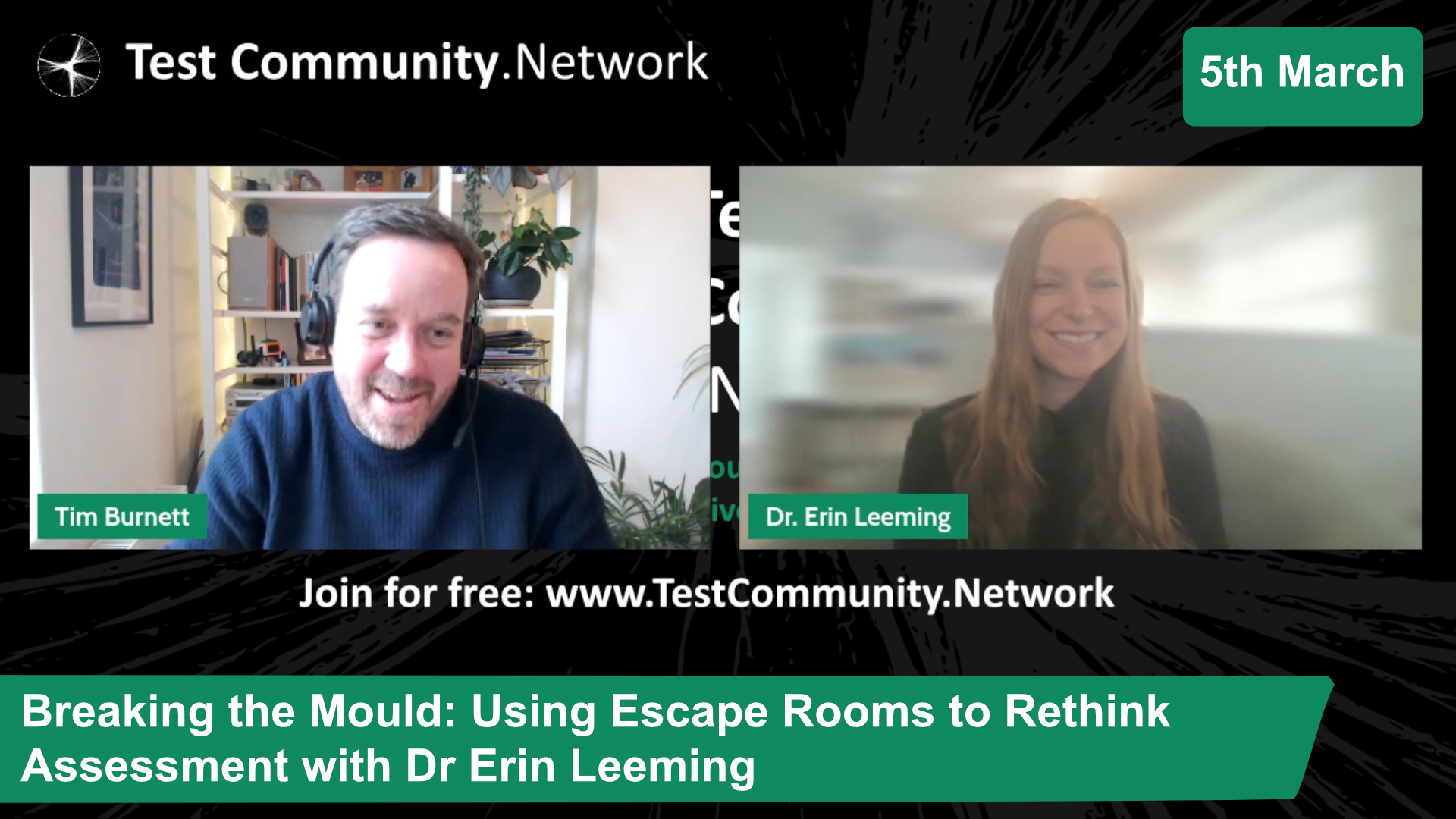
Breaking the Mould: Using Escape Rooms to Rethink Assessment with Dr Erin Leeming
What happens when you swap a traditional exam for an escape room? Dr. Erin Leeming, a lecturer at the University of Central Florida, decided to find out — and the results have lessons for anyone rethinking how we assess learning.
Published: 3/4/2026
Dr. Leeming is a speech language pathologist by trade, having spent years working in schools with students from third grade through to high school who experienced communication difficulties. Now teaching phonetics at university level, she began looking for ways to make assessment more meaningful — and less stressful — for her students.
"I have ADHD and I know some of my students also have different learning differences. There's all of this test anxiety that happens for some people and I was trying to create a safe space for people to show what they know in a different way."
— Dr. Erin Leeming, Lecturer, University of Central Florida
The idea came from a casual conversation with a colleague. Phonetics, Dr. Leeming explains, is like learning a new language — making it a natural fit for gamification. She worked with a team over two to three months to build an immersive escape room experience, complete with projected graphics on the walls, where students worked in teams to decode the International Phonetic Alphabet and solve puzzles to progress through the room.
Students had already completed a traditional exam two weeks earlier, which included multiple choice, true or false, short answer, and IPA transcription. The escape room took a different angle — focusing on reading IPA and translating it into English to unlock clues. The contrast between the two experiences was striking.
"I had a lot of people saying that they didn't realise how much they knew until they experienced this way. On the exam, they felt like they were more flustered already because it's an exam. You have that pressure already. Yes, the escape room was an exam, but there was no pressure behind it built up."
— Dr. Erin Leeming, Lecturer, University of Central Florida
Despite the lower perceived stakes, students still came prepared. Dr. Leeming believes the combination of the earlier exam and build-up activities throughout the semester meant students arrived confident and ready — without the anxiety that typically accompanies a final assessment.
In terms of the time investment, Dr. Leeming estimates she spent around ten to fifteen hours on her side — comparable, she says, to building out a traditional exam in Canvas. And now that the template exists, future iterations should take even less time.
But the escape room is just the beginning. Dr. Leeming is already working on her next innovation — using a hologram machine to create lifelike clinical scenarios for her students. She recorded her daughter acting as a patient, and students will use the hologram to practise administering a speech language pathology assessment.
"I just think it gives it more of a real life feel. You're stepping into realising that this is a real human being that you're helping and you need to take their perspective into consideration."
— Dr. Erin Leeming, Lecturer, University of Central Florida
At the heart of all of this is a simple motivation: helping students feel ready for the real world. In a sector grappling with AI, academic integrity, and assessment methods that haven't fundamentally changed in centuries, Dr. Leeming's approach offers a refreshing way forward.
"I just want to help instil that confidence. I want to give them those real world experiences so that they feel prepared when they go to the real world and they're like, this is kind of similar to what I've already done. So I know I can do this."
— Dr. Erin Leeming, Lecturer, University of Central Florida
Whether it's escape rooms, holograms, or whatever comes next, one thing is clear — Dr. Leeming is proving that assessment doesn't have to be something students dread. It can be something that builds them up.