Code Without Coders: What the Rise of Vibe Coding Means for Assessment
How vibe coding, AI-native platforms, and malleable software are about to reshape the assessment vendor landscape, and what awarding organisations need to do now.
How vibe coding, AI-native platforms, and malleable software are about to reshape the assessment vendor landscape, and what awarding organisations need to do now.
In February 2026, three hundred billion dollars was wiped from the valuations of SaaS companies in what many are now calling the "SaaS Apocalypse." The trigger? A growing realisation that non-technical people can now build their own software — using nothing more than natural language and an AI coding tool. When a CNBC journalist cloned Monday.com live on air in under an hour, the market took notice. But what does this shift mean for the assessment industry — an industry built on SaaS platforms, long procurement cycles, and deeply embedded vendor relationships?
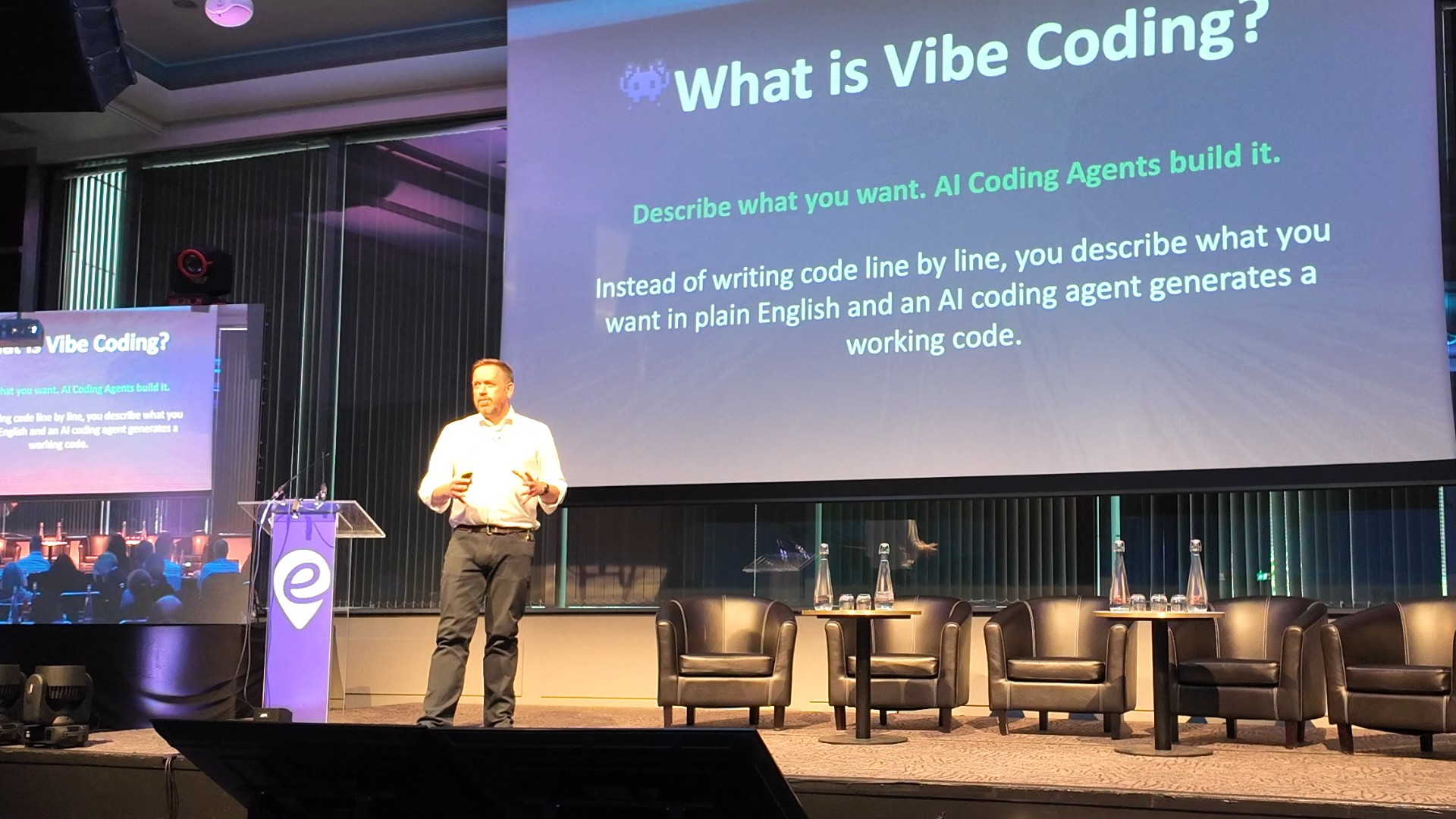
That was the central question explored in a recent presentation by Tim Burnett, founder of the Test Community Network and education technology consultant, delivered at the AI Symposium during the EAA Conference in London. The session — titled "Code Without Coders" — drew such a strong response from delegates that Tim published a full rerun with additional insights and a live demo for those who couldn't attend.
"So many people came up to me afterwards, either wanting to understand more about vibe coding or to share their own stories. So many people who are doing really, really fascinating, innovative work with it."
— Tim Burnett, Founder, Test Community Network
Vibe coding — a term first coined by Andrej Karpathy and named Collins Dictionary's word of the year — refers to the practice of building software through conversation with an AI agent. Rather than writing code line by line, you describe what you want in plain English (or even by voice), and the AI builds it. Platforms like Lovable, Replit, and Base44 now offer full-stack app building where you can go from idea to deployed product — complete with database, security, SEO, and domain management — within hours.
For developers, the shift has been equally profound. Tools like Cursor, GitHub Copilot, Claude Code, and Codex have transformed the role of the developer from individual coder to orchestrator — managing a team of AI agents working across multiple code projects simultaneously. According to Y Combinator, ninety-five percent of the code in their 2025 batch of startups was AI-generated.
"If I can spend five to fifteen dollars creating my own version of all the features that I want — the things I actually wanted to do, not what I'm told it can only do — then it seems like a bit of a no-brainer."
— Tim Burnett, Founder, Test Community Network
Tim's presentation traced the history of SaaS — software built by one company for many clients, hosted in the cloud, accessed via web interfaces — and examined why the model is now under strain. At its core, SaaS is a database with workflows, permissions, and a user interface layered on top. Customers pay subscriptions for access to features designed for a broad market, and if they want something bespoke, they either pay handsomely for it or go without. Costs scale with every additional seat, and feature requests disappear into backlogs that stretch out for years.
The question the market is now grappling with is straightforward: if a non-technical user can spin up a custom version of the features they actually need for a fraction of the cost, how long does the traditional model hold?
Tim's answer is nuanced. He doesn't believe SaaS is dead. What he sees coming is a mutation — a fundamental reshaping of how platforms are built, sold, and used.
To ground the discussion in the realities of the assessment industry, Tim conducted a moat analysis of twenty-nine assessment platform vendors — examining their defences against disruption across eleven criteria. These included data assets, regulatory credentials (such as ISO accreditation), physical infrastructure like test centres, ecosystem dependencies, financial resilience, team depth, trust, culture, and scalability.
The analysis revealed clear clusters. Some vendors sit on powerful moats — proprietary data sets, deep regulatory compliance, physical infrastructure that's hard to replicate, and embedded positions in their clients' workflows. Others, particularly those whose primary offering is a user interface over a commodity database, look far more exposed.
"One of the vendors from that list — speaking to someone at the conference — they've already seen the effect and made some changes and effectively sold the business. So, you know, things are happening."
— Tim Burnett, Founder, Test Community Network
Tim was careful to note the limitations of the research — conducted using ChatGPT's Deep Research — and stressed that human expert judgement is essential when interpreting the results. Some vendors positioned low in the analysis are actually taking innovative, disruptive approaches that an AI research tool might not fully capture. The message was clear: moats are real, but they're shifting. What protected you five years ago may not protect you in two.
The presentation mapped assessment vendors into three broad categories based on their readiness for what's coming. At the bottom are the AI-resistant organisations — those actively blocking adoption, stifling experimentation, and treating AI as hype. Tim's advice here was blunt: if you're building a career in this space and your organisation is AI-resistant, it might be time to question whether you want to stay.
In the middle sit the AI-emerging organisations — legacy platforms that have been around for years and are now bolting AI features onto existing infrastructure. They have the customers, the contracts, and the trust. But they're working with legacy codebases and their innovation cycles are slow. Tim raised an uncomfortable question that some vendors are already asking themselves: why keep pouring money into old rope when you could spin up a brand new AI-native platform in six months that's significantly better and cheaper to build?
At the top are the AI-native organisations — those built from the ground up with AI at their core. Small teams. Lean operations. AI woven into everything from their organisational structure to their codebase. Tim referenced an Anthropic report suggesting that organisations of a hundred people could soon be doing the work currently done by a thousand — with revenue per employee potentially reaching a million or more.
The standout moment of the session was Tim putting his ideas into practice. Rather than writing a memo about what an AI-native assessment platform might look like, he built one. Using Lovable, he created an AI-native item bank in around two hours — a functional platform with AI-powered item generation, multilingual duplication (items translated into French on command), and a chat interface for interacting directly with the bank.
But the real revelation was the concept of custom interfaces. Tim demonstrated how users could vibe code entirely new features into the platform through conversation — a psychometrician's report analysing item quality, an enemy item detection tool, a comparative judgement interface for difficulty reviews, a full item editor, even an AI image generator for questions. Each one built by simply telling the platform what to create.
"The idea that you can take a core platform and just chat away to add your own features into it — that could be quite an exciting thing."
— Tim Burnett, Founder, Test Community Network
Tim outlined three interconnected ideas that he believes will reshape the vendor-client relationship in assessment.
The first is headless SaaS — the idea that you buy a secure, robust core infrastructure (database, security, scalability) from a vendor, and build your own user interfaces, widgets, and features on top of it. The platform becomes a foundation, not a finished product.
The second is forward-deployed engineers — a model borrowed from companies like Palantir, where the vendor embeds a dedicated technical person or small vibe coding team within your organisation. Instead of the traditional back-and-forth with a project manager who acts as a "carrier pigeon" between you and a distant development team, you get someone who knows the platform's APIs and framework, understands your needs, and can build features before the end of the day.
The third is malleable software — platforms designed from the start to be shaped by their users. No more agonising over build vs. buy. You're effectively doing both at the same time. You buy the core that everyone trusts, and you vibe code in everything else.
Tim also flagged a financial challenge that the industry hasn't fully grappled with yet. As AI features become embedded in assessment platforms, token-based costs introduce a new kind of unpredictability. He cited reports of organisations burning through their entire AI budgets within months — including one account of a five-hundred-million-dollar bill from unchecked Claude Code usage. The traditional per-seat subscription model gave CFOs something they could budget for. A world where AI usage scales unpredictably with every user's activity is a different proposition entirely. Per-test pricing, Tim suggested, will likely endure because it ties cost to tangible value — but the industry needs new thinking around how to manage AI-driven costs at scale.
Threading through the entire presentation was Tim's guiding framework: think human first, AI forward, agent ready. Humans aren't going anywhere — they remain central to questions of fairness, value, and whether something should be done at all. But AI capabilities are advancing at an extraordinary pace, and the organisations that thrive will be those that lean in, learn, and build the infrastructure to work alongside increasingly capable AI agents.
For the assessment industry — a sector Tim acknowledges typically runs about five years behind the broader technology curve — the message is that now is the time to start. Not in two years when the procurement cycle finally turns, but today. Whether that means experimenting with vibe coding tools, rethinking vendor relationships, running internal hackathons, or simply giving your team the space and permission to explore — the cost of waiting is becoming harder to justify than the cost of starting.
"Can one person alongside vibe coding replace an enterprise provider? I don't think so. Not yet anyway. But a small team of experts, all augmented with different AI tools — that could make a significant change."
— Tim Burnett, Founder, Test Community Network
Watch the full presentation on the Test Community Network. Connect with Tim Burnett on LinkedIn.