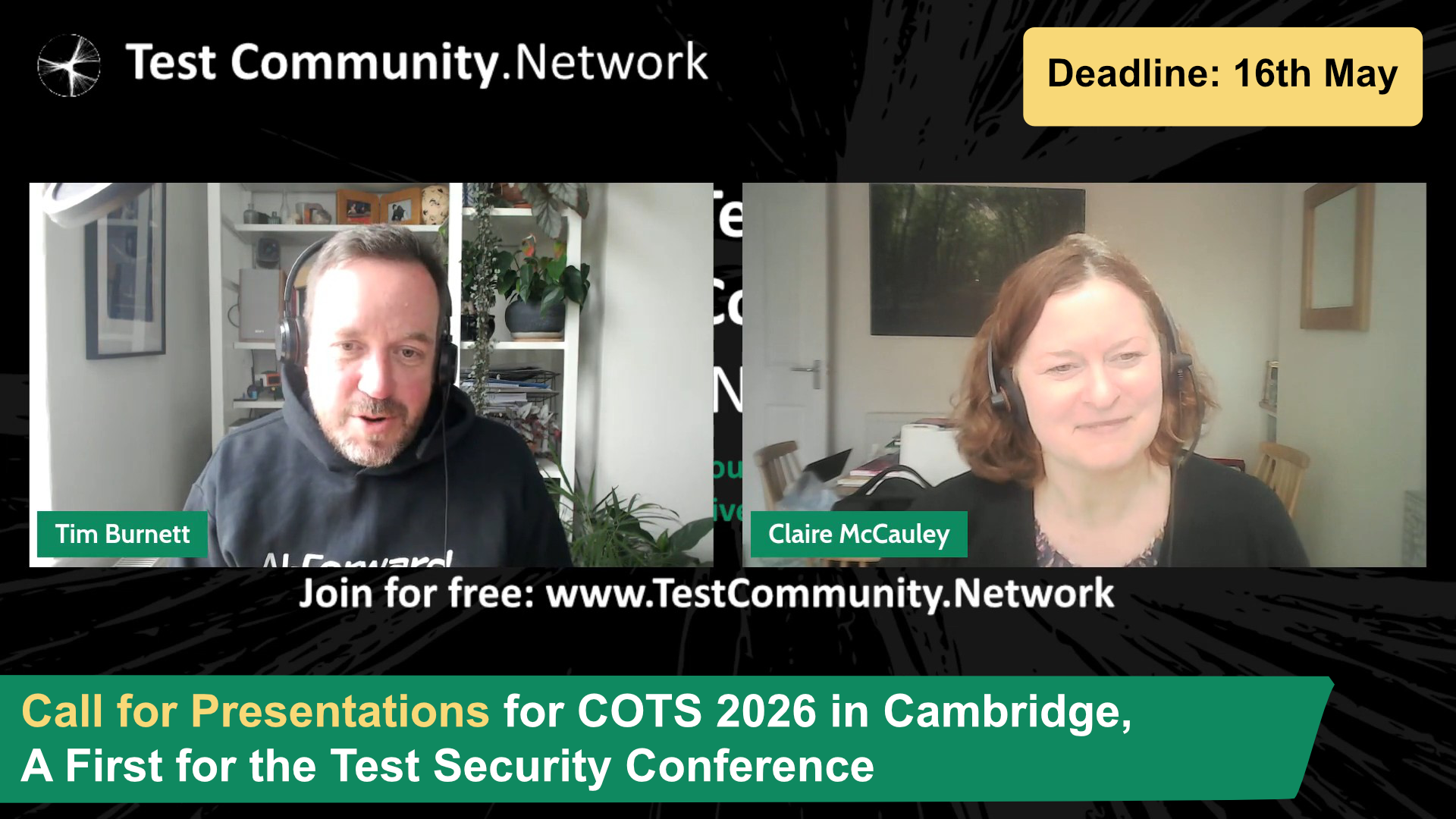
COTS 2026 in Cambridge: A First for the Test Security Conference
In conversation with Claire McCauley at Cambridge University Press & Assessment, about The Conference on Test Security (COTS), and why the 2026 edition is heading to Cambridge for the first time outside the United States.
Published: 4/21/2026
For the first time in its history, the in-person leg of the Conference on Test Security (COTS) is leaving the United States and heading to Cambridge. For UK and European assessment professionals, that's a rare opportunity to attend a niche but increasingly important annual gathering without a transatlantic flight.
Claire McCauley, Senior Leader in Global Operations & Assessment Security at Cambridge University Press & Assessment, joined Tim Burnett on the Test Community Network podcast to share the news, talk through what to expect from the programme, and encourage practitioners to submit proposals before the 16 May deadline.
"Conference on Test Security, COTS — we hold it every year and every year it's in the US. It's very niche, it's very specific to people who work on test security: how we combat fraud in assessment."
— Claire McCauley, Senior Leader in Global Operations & Assessment Security
That niche focus is precisely what makes COTS valuable. It pulls together a community of professionals who rarely have a single venue dedicated to their specific challenges — statistical detection of fraud, secure delivery, brand integrity, and the constantly shifting threat landscape around digital and remote assessment.
"This year, for the first time ever, the in-person part of the conference is happening outside of the US. We're hosting it here in Cambridge in the UK."
— Claire McCauley, Senior Leader in Global Operations & Assessment Security
The shift across the Atlantic significantly lowers the barrier for European delegates — both in cost and in travel time. Claire was clear that this is an opportunity she'd love to see UK and European practitioners take up.
"I'm really keen for anybody who's based in the UK or Europe, who has an interest in test security or works in that area. It's a great chance to come and attend this conference."
— Claire McCauley, Senior Leader in Global Operations & Assessment Security
The programme itself spans a broad mix of approaches. Some sessions dig deep into psychometrics and statistical methods for spotting irregular response patterns. Others tackle the operational security side — how organisations actually deliver secure exams at scale, often across multiple countries and time zones. Remote proctoring and digital testing tend to feature heavily, reflecting where much of the current risk and innovation lives.
One concern Tim raised was whether the conference is approachable for people who are newer to test security as a discipline. The answer was encouraging.
"If you're new to it, it's really useful — you get to attend sessions that can explain a lot of the basic bare bones of how to manage test security. Most years there's a lot that's accessible to people who are newer to this area."
— Claire McCauley, Senior Leader in Global Operations & Assessment Security
That accessibility matters. Test security is a discipline that often grows organically inside awarding organisations — someone gets handed responsibility for it alongside another role and has to learn fast. A conference that provides both deep specialist content and "Test Security 101" sessions is well placed to support people across that learning curve.
"Anywhere where you need an assessment to prove your skills — that's the kind of breadth we see. Lawyers, doctors, nurses, radiographers, English language testing — lots of different industries."
— Claire McCauley, Senior Leader in Global Operations & Assessment Security
That cross-sector mix is one of the conference's quieter strengths. The fundamentals of fraud, candidate authentication, and the integrity of a result are common across awarding bodies, regulators, professional certification bodies and language testing providers — even when the surface details differ. Bringing those perspectives into one room produces conversations that wouldn't easily happen anywhere else.
The call for proposals is open now. Papers can be submitted until 16 May, with poster proposals open until 1 September. Sessions can range from 15-minute presentations through to 60-minute panels and two-hour hands-on workshops, so there's flexibility in how you choose to share your work. Whether you're presenting or simply attending, Cambridge in 2026 looks like a fixture worth getting on the calendar.