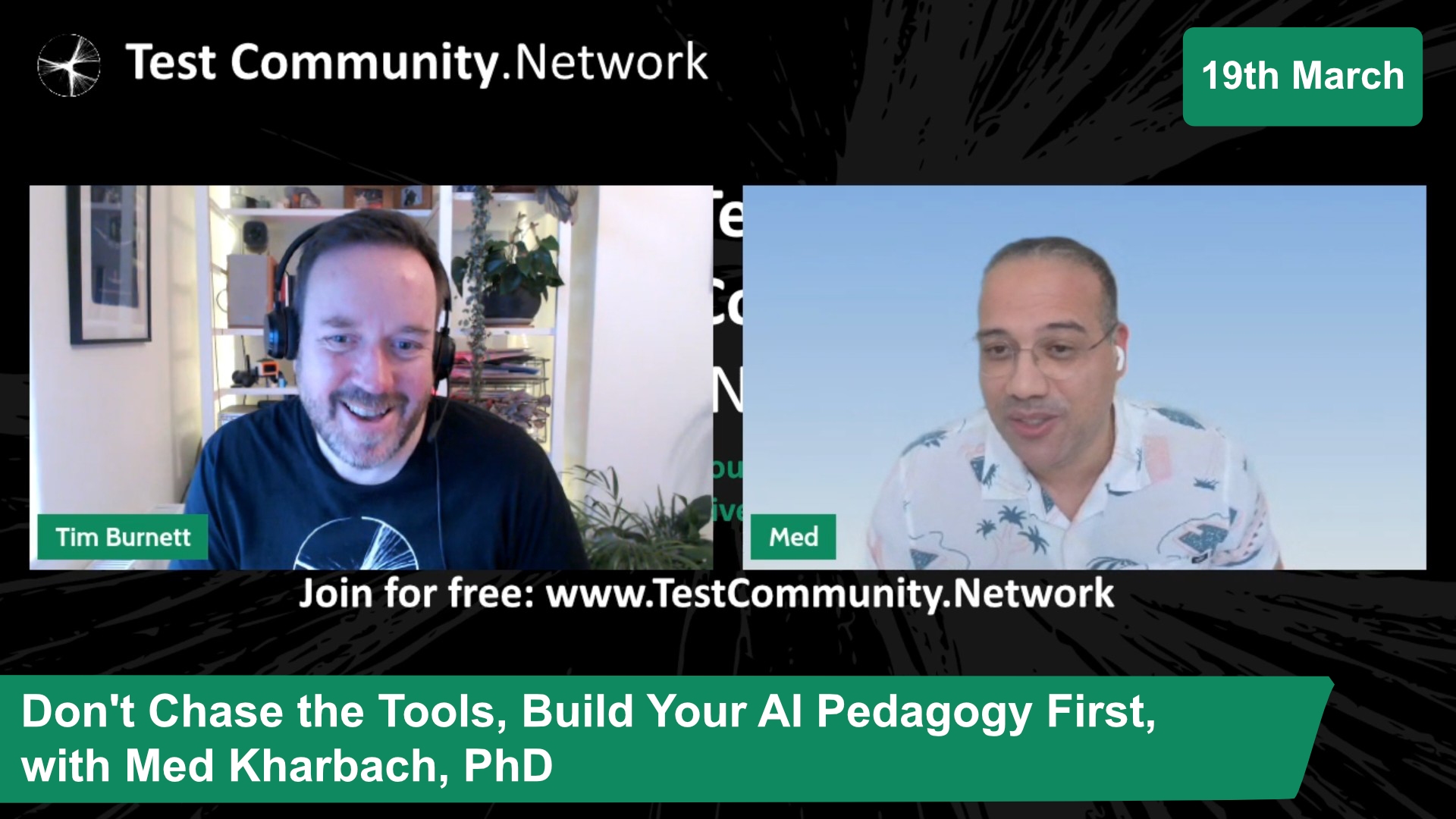
The conversation around AI in education has shifted. A year ago, educators were still debating whether AI belonged in the classroom at all. Today, that question feels almost quaint. AI is here, students are using it, and the real challenge now is not whether to engage with it — but how.
Med is an educator, researcher, and part-time faculty member at Mount Saint Vincent University in Canada. A former English as a foreign language teacher, he pivoted his research focus towards AI when the technology began reshaping how students learn and how teachers teach. He has since become one of the most prolific and generous voices in the space, co-authoring multiple publications and producing a library of freely available practitioner guides designed to bridge the gap between academic research and classroom reality.
"When I work on research projects, the academic language is sometimes not accessible to teachers who are doing a lot of work in their classroom. So I turn a lot of those insights into guides that teachers can take with them to the classroom and use in their own teaching practice."
— Med Kharbach, PhD, Educator and Researcher, Mount Saint Vincent University
Those guides, covering everything from what AI-literate students do differently to how educators can rethink assessment design, are born not just from research, but from ongoing conversations with teachers across social media and LinkedIn. Med describes them as written "from a teacher to the teacher," deliberately stripped of jargon and focused on practical application.
The conversation quickly turned to one of the most pressing concerns for educators today: assessment. In a world where any student can generate a polished essay in seconds, traditional assignments are losing their value as measures of learning. Med argues that assessment needs to shift from evaluating outputs to making the learning process itself visible.
"Assessment in the age of AI should focus more on the learning process rather than the final product. We need to see how students think, not just what they submit."
— Med Kharbach, PhD, Educator and Researcher, Mount Saint Vincent University
He advocates for layered approaches, reflective journals, oral defences, chat log submissions, and process documentation, that reveal how a student has engaged with both the material and the AI tools available to them. These methods, he acknowledges, work well in smaller class settings. In his own graduate courses, where class sizes cap at around sixteen to twenty students, there is room for that depth. But he is candid about the scalability challenge facing teachers with far larger groups.
On that front, Med highlighted some promising developments, including software that analyses student-AI chat logs against a set of analytic criteria, assessing the depth and authenticity of interactions. Tools like this could help teachers managing large cohorts to evaluate AI-assisted work without needing to manually review hundreds of pages of conversation transcripts.
"If a student brings you a three hundred page chat log, that's a lot. You can't go through all of that. Using AI to help analyse those interactions is another way to look at it."
— Med Kharbach, PhD, Educator and Researcher, Mount Saint Vincent University
But Med is equally clear about the ethical boundaries. He would not feed student work into a chatbot without first stripping it of all sensitive data — names, identifying information, anything that could compromise privacy. The conversation touched on the broader complications here, particularly in the UK where student submissions may be considered the property of the student, and in vocational settings where apprentices' work may contain commercially sensitive information from their employers.
The discussion also explored how rapidly AI capabilities have evolved. Med and Tim reflected on how AI-generated images just two or three years ago were riddled with errors — garbled text, distorted faces — and how the technology has now reached a point where outputs are often indistinguishable from human-created content. Med pointed to a hierarchy of AI performance: tasks involving coding, mathematics, and statistics are significantly ahead of those requiring creative expression or visual generation, though the gap is closing fast.
Perhaps the most resonant moment came towards the end, when Tim asked Med what advice he gives to educators who are still finding their footing with AI. His answer was disarmingly simple: start with your mindset.
"If you're coming to AI from a background that is anti-technology, then it would be hard for you to embrace it within your teaching. The more you use AI in your own life as a teacher, the more open and friendly take you will have towards AI within your work with your students."
— Med Kharbach, PhD, Educator and Researcher, Mount Saint Vincent University
His core message was refreshingly grounded: don't chase every new tool. Don't feel the pressure to keep up with every update and every product launch. Instead, focus on building your AI pedagogy first. Learn to prompt well. Get comfortable with one or two mainstream chatbots. That, Med argued, is more than enough for most teachers to start transforming their practice.
"Don't focus on the tool. Focus on building your AI pedagogy first. If you have a strong prompting skill, you don't even need other tools — you only need a chatbot."
— Med Kharbach, PhD, Educator and Researcher, Mount Saint Vincent University
It is a message that cuts through the noise — and one that educators at every level would do well to hear.
Explore Med Kharbach's research and free educator guides at medkharbach.com.
Connect with Med Kharbach on LinkedIn.
Connect with Tim Burnett on LinkedIn.
Listen to the full episode and explore more conversations on the Test Community Network.