Exams, Coursework or Both?
What the OECD Found Across 38 Countries
What the OECD Found Across 38 Countries
How should we assess young people at the end of school? It's a question that sparks fierce debate in education systems around the world, and one that a major new OECD report has set out to answer by looking at what countries actually do in practice. The findings challenge some deeply held assumptions.
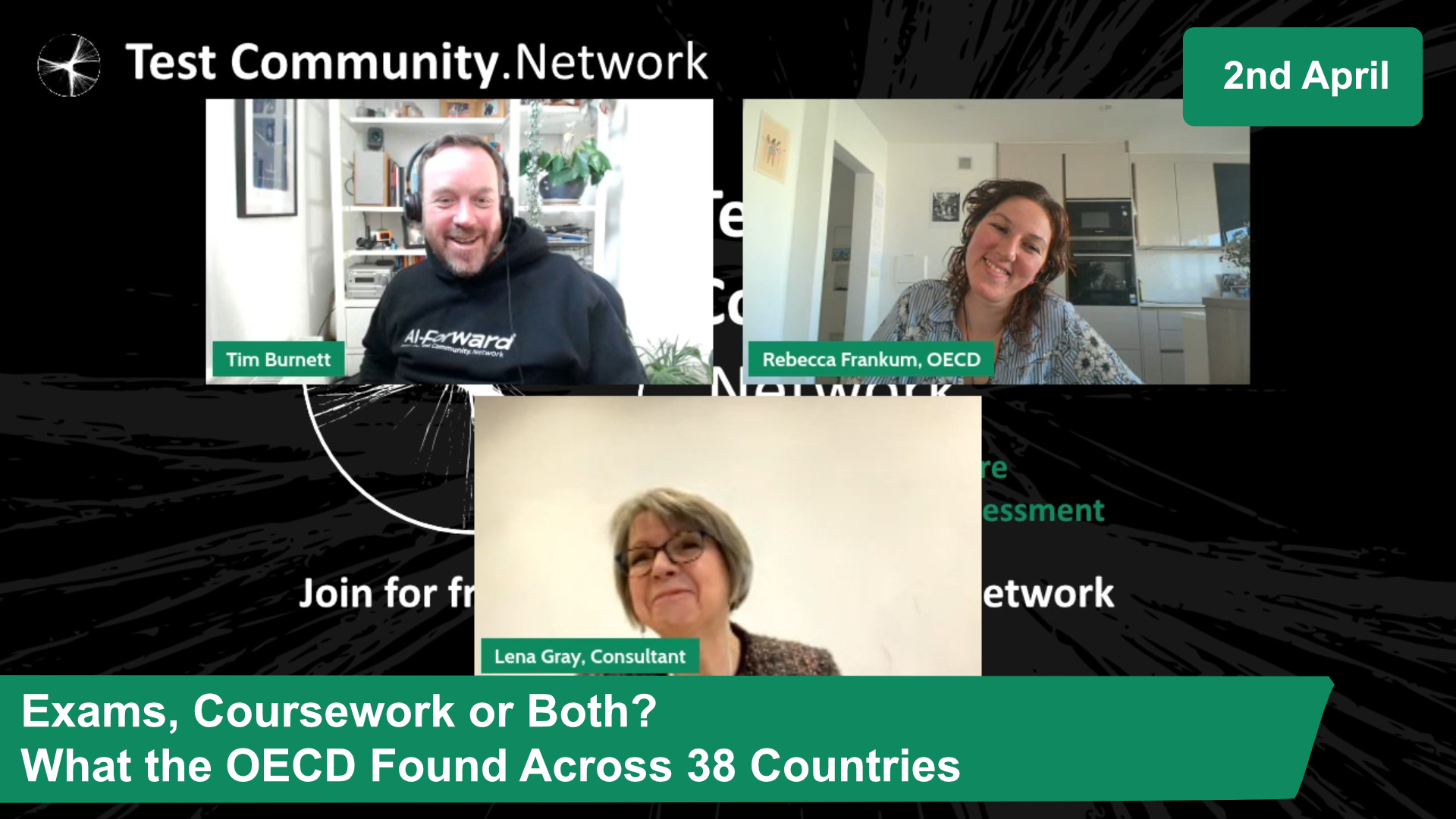
Published in January 2026, The Theory and Practice of Upper Secondary Certification is one of the most comprehensive international studies of high-stakes assessment ever undertaken. The research team mapped 71 different certificates across 38 education systems, examining not just what assessment formats countries use, but who sets and marks them, how they are delivered, and under what conditions. Part of the project team was led by Rebecca Frankum, Policy Analyst at the OECD, with Dr Lena Gray contributing as a consultant assessment researcher.
"The school-leaving certificates and qualifications that young people get when they finish school are deeply important for their lives. They matter as they transition to their next steps — whether that's higher education, further education or employment. They matter deeply for society. They set the goalposts of what it is that we want young people to achieve."
— Rebecca Frankum, Policy Analyst, OECD
A common assumption in assessment debates is that systems fall neatly into two camps: those that rely on external exams and those that use teacher-based assessment. The OECD's mapping exercise found the reality is far more nuanced. Of the 71 certificates studied, only ten were entirely externally assessed. Nineteen were entirely internally assessed with no external exams. The largest group — the remainder — used a combination of both, with internal assessment and external exams complementing each other in some way.
"Polarised and binary arguments just don't hold when you look at what happens in practice."
— Dr Lena Gray, Consultant Assessment Researcher
The research also unpicked the debate around continuous assessment versus endpoint assessment. Proponents of continuous assessment often argue it gives students multiple opportunities and reduces the pressure of a single high-stakes event. But the report found evidence that students themselves don't always see it that way — many reported feeling constantly assessed, under persistent pressure, and unable to prepare properly to show their best work. Endpoint exams, meanwhile, are valued by some for creating a level playing field, but criticised by others for failing to capture the full range of a student's skills and knowledge.
Rather than declaring one approach superior, the report proposes four principles for evaluating whether an assessment system is fit for purpose: relevance, credibility, fairness and manageability. Crucially, these are not technical metrics requiring specialist expertise — they are designed to help policymakers, educators and qualification agencies have productive conversations about the trade-offs involved in any assessment design.
"There is no perfect approach. There is only what is appropriate for that purpose, in that context, at that time."
— Dr Lena Gray, Consultant Assessment Researcher
Higher education emerged as a significant influence on assessment design, though not always in the way one might expect. Where university admissions are competitive, systems tend to prioritise the credibility and reliability of external exams. But higher education institutions are also increasingly advocating for the assessment of higher-order skills — critical thinking, resilience, independence — that traditional exam formats can struggle to capture. In some systems, universities are beginning to lead the conversation about how these skills might be assessed differently.
One of the report's most striking themes was the role of assessment culture. Deep-seated national attitudes towards exams and teacher assessment can prove remarkably resistant to reform, regardless of what the evidence suggests. Some cultures place enormous trust in teacher professionalism and view external assessment as an affront to it; others trust only external exams and regard teacher assessment with suspicion. Most of the countries involved in the study were either planning or undergoing reform of their upper secondary assessment systems, and convincing the wider public of the case for change was a significant challenge for all of them.
"What's important in a changing world is that the fundamental questions remain the same. What is the purpose of this assessment? What do we want students to be learning? What do we want to be assessing? Designing good assessments is always going to be the most important thing."
— Rebecca Frankum, Policy Analyst, OECD
Looking ahead, there is value in building on this work by exploring marking, moderation and standard setting in greater depth — a pressing concern for countries introducing more teacher-assessed components. Other priorities include understanding the student experience of high-stakes assessment and how best to support teachers in developing the skills and confidence to deliver valid and reliable assessments. In a world where AI is adding yet another layer of complexity, the case for continued international research and collaboration has never been stronger. Whilst there are so many options, Rebecca was keen to stress that future research plans would come down to the value they would bring to the OECD members.
Read the full report: The Theory and Practice of Upper Secondary Certification (OECD, published 28 January 2026)
Connect with Dr Lena Gray on LinkedIn: linkedin.com/in/dr-lena-gray-assessment-researcher
Connect with Rebecca Frankum on LinkedIn: linkedin.com/in/rebecca-frankum-81a444166