Forty Years of Getting Assessment Right (and Wrong)
Rick Jones on AI, Item Banks and Why Educators Still Matter
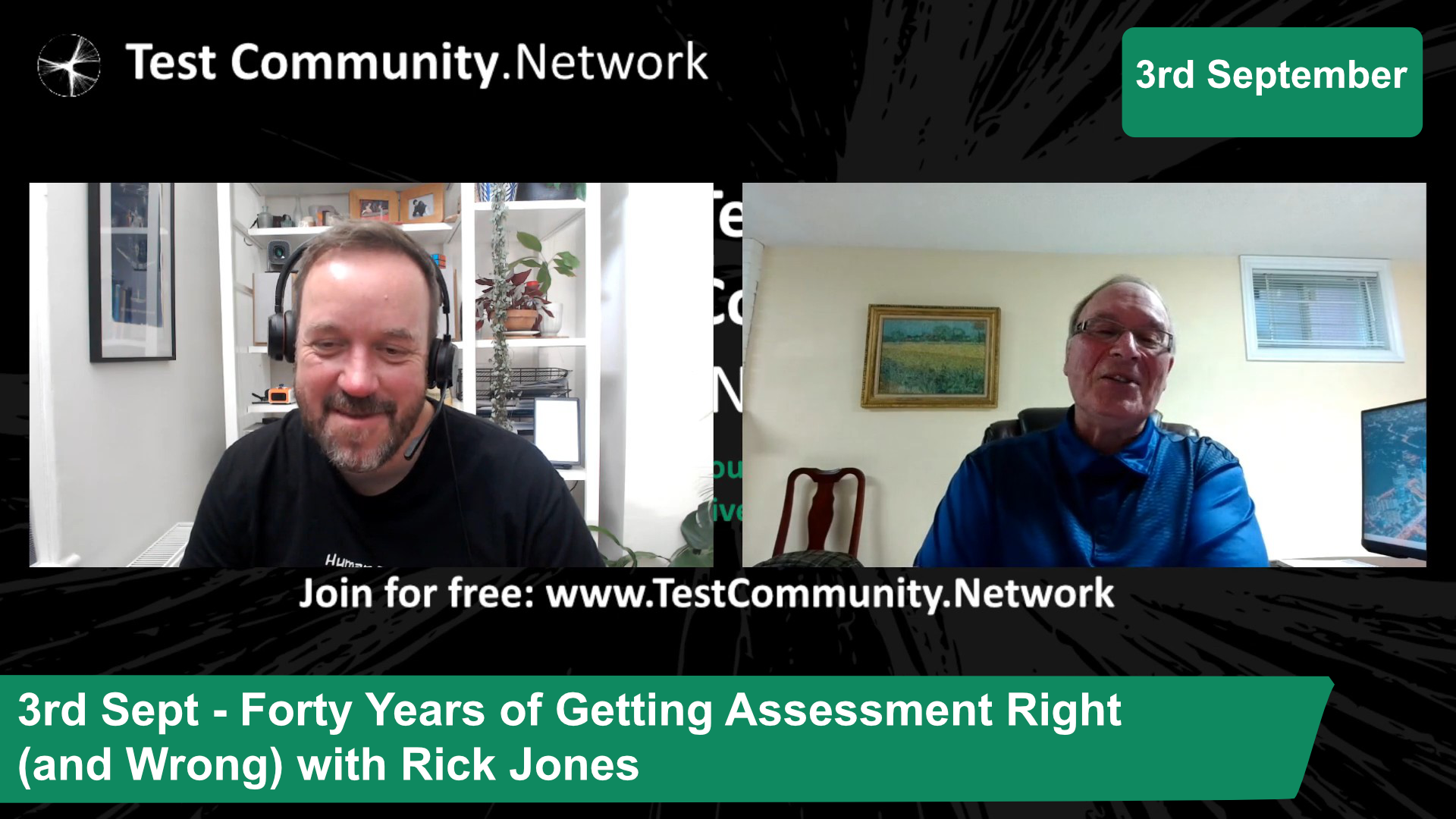
Rick Jones on AI, Item Banks and Why Educators Still Matter
What do you learn after forty years in assessment? That the field never stands still, that failures teach you more than successes, and that every new technology brings the same fundamental question: where does the human fit? Tim Burnett sat down with Rick Jones, an independent assessment consultant whose career has spanned classrooms, ministries and testing organisations across Canada, to talk about what has changed, what is coming next, and what the global assessment community should be paying attention to ahead of the IAEA 2026 conference in Toronto this September.
Rick founded RMJ Assessment in 2018 after retiring from Ontario's Education Quality and Accountability Office, where he served as Director of Assessment. His career has taken him through roles in British Columbia, Saskatchewan and Ontario, spanning item development, test construction, programme evaluation and quality assurance auditing. He now consults with jurisdictions and awarding bodies across Canada and internationally, and organises the annual Pan-Canadian Forum bringing together assessment professionals to discuss issues of common interest.
"For many years, the conversation was all about moving paper-based assessments into digital format. That's what the main focus was. And today, the vast majority of Canadian provinces and territories have now moved into a digital assessment format."
— Rick Jones, President, RMJ Assessment
With that transition largely complete across Canada, the focus has shifted decisively to artificial intelligence. At the most recent Pan-Canadian Forum in December, the topic was AI in assessment, and Rick says interest was intense. Two applications are generating the most energy: using AI to support item generation, and using it for constructed response scoring. Two or three Canadian jurisdictions are already piloting or implementing AI in both of these areas.
"People really interested in AI to support them with item generation, and also in using AI for constructed response scoring. Those are two really large areas of interest right now."
— Rick Jones, President, RMJ Assessment
Rick is clear that enthusiasm for AI must not become an excuse to remove educators from the process. Whether it is developing items or training machines to score constructed responses, human judgement remains essential. AI brings efficiency, but the checks and balances that ensure validity and reliability still require people. The goal is augmentation, not replacement.
"It's not just turning everything over to AI, but certainly using it as a way of bringing efficiencies to the process. You've got to have educators involved, whether it be developing items or doing scoring to train the machines."
— Rick Jones, President, RMJ Assessment
The conversation took a fascinating turn when Tim asked whether candidates themselves should be given access to AI tools during exams. Rick drew a parallel to earlier debates about whether students should be allowed dictionaries, thesauruses and calculators during paper-based tests. He sees potential for a future where candidates use AI to develop their work, exercising their own judgement about what is appropriate, and even for assessment items that ask candidates to critique AI-generated content.
"I think in the long term, there's the potential for candidates to be able to use AI in developing their products, and being able to use their own judgement in terms of appropriately working with it to come up with the best possible product."
— Rick Jones, President, RMJ Assessment
With the IAEA conference arriving in Toronto on 27 September, Rick is looking forward to bringing his perspective on both the successes and failures he has witnessed across four decades. He is particularly keen to explore whether the global community is tackling early maths and literacy screening, an area of growing concern in Canada and likely well beyond. He also wants to learn from the exhibition hall, meeting product teams and hearing what new approaches are emerging from the international assessment community.
"I've discovered some effective practices for supporting trust and transparency and integrity in assessment as you're developing programmes. But I'm also still really interested in learning."
— Rick Jones, President, RMJ Assessment
Rick has also launched a profiling initiative through RMJ Assessment, recognising notable leaders in large-scale student assessment across Canada and internationally. Created through an interview process, the profiles aim to highlight the deep expertise present in the sector, connecting people who may not know about each other's work even within the same country. The collection now includes profiles of IAEA 2026 conference ambassadors, and new profiles are added regularly.
Explore the Expert Profiles: rmjassessment.com/profiles-in-educational-assessment
The IAEA 2026 conference takes place in Toronto from 27 September. Whether you are exploring AI in assessment, interested in early screening, or simply want to connect with the global assessment community, it promises to be one of the year's most important gatherings.
Register for IAEA 2026: https://iaea2026.org/
Connect with Rick Jones on LinkedIn: linkedin.com/in/richard-jones-65b43330
Connect with Tim Burnett on LinkedIn: linkedin.com/in/tburnett