Is There Really a Maths Gene?
What a Maths Professor Learned About Beating Maths Anxiety
What a Maths Professor Learned About Beating Maths Anxiety
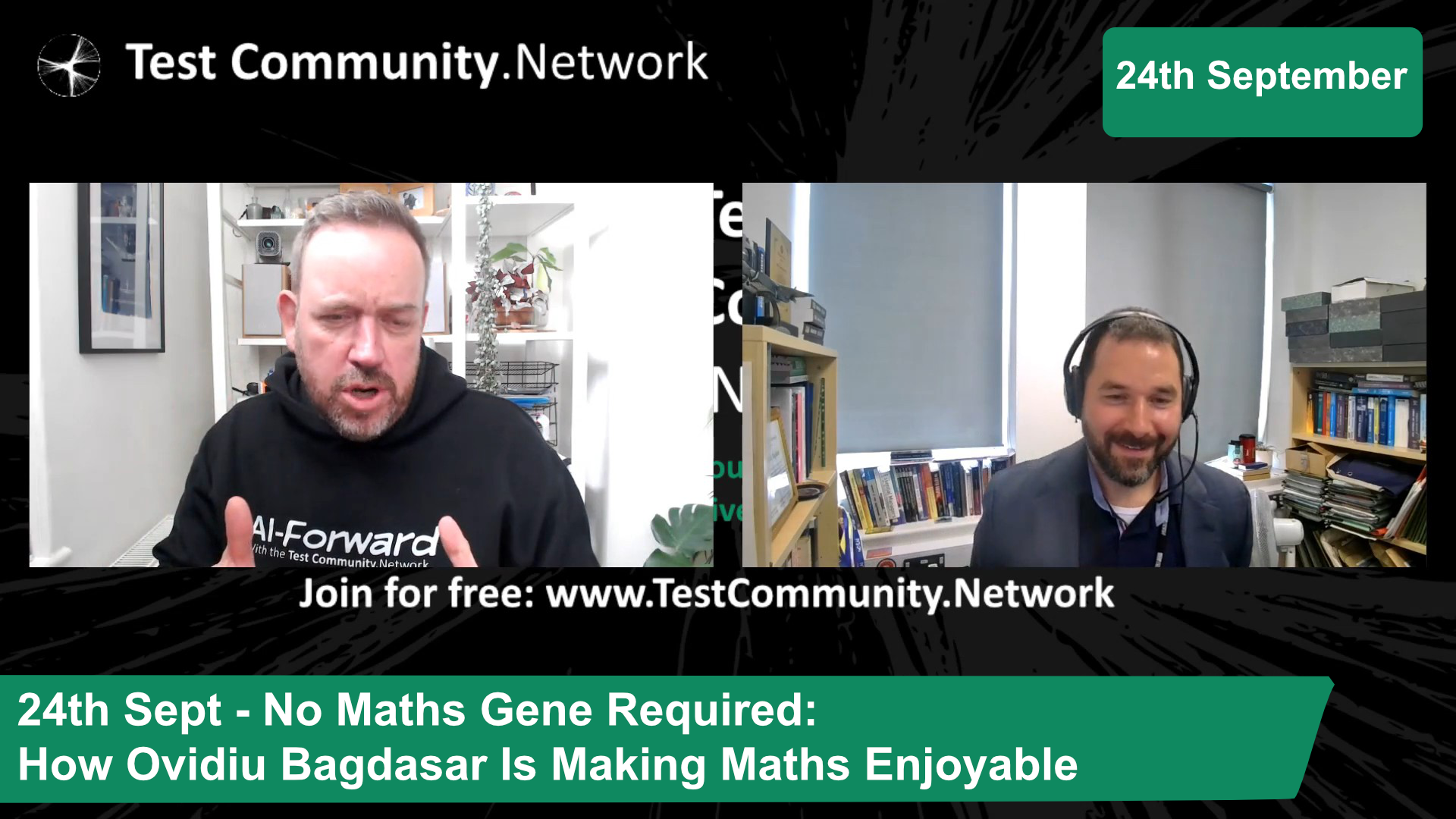
Why do so many people say they are "just not a maths person"? In this episode of the Test Community Network podcast, Tim Burnett speaks with Professor Ovidiu Bagdasar about maths anxiety, meaningful assessment, falling maths performance and the role of AI, and why he believes everyone can learn to enjoy maths.
Ovidiu is Professor of Mathematics at the University of Derby, where he has taught for fifteen years. He holds two PhDs in mathematics, one in applied and one in pure, and has spent much of his career teaching students who did not want to be taught maths. Many arrived with a low skill base, and many more arrived with maths anxiety, which he sees as very prevalent in the UK.
Maths anxiety is not a lack of ability. Ovidiu describes it as the brain reacting to a maths task as if it were a threat, which stops people using skills they already have.
"It's not a failure of the brain. You can be fully capable of doing the mathematics, but your brain is freezing when having to deal with some task just because it perceives it as a threat and something unpleasant."
— Professor Ovidiu Bagdasar, Professor of Mathematics, University of Derby
To help his students, Ovidiu needed resources that were available at all times, flexible, meaningful and accessible. That need is what brought him into the world of e-assessment.
For his first module, Ovidiu wrote 800 questions, each with multiple versions. When a test was generated, one version of each question was randomly drawn from a pool. Students received feedback straight away, could revise the relevant lesson and then retake the test.
With around 150 students on the module, the approach helped pass rates reach 85%, with student satisfaction of 90 to 95%. The student feedback told the story: one learner who had barely scraped a C at GCSE said they finally enjoyed maths and did it in their own time. Others described the e-assessment as the ideal revision tool.
The results caught the attention of his dean, particularly as pass rates on similar engineering modules were around 40%. But building the question bank had taken Ovidiu a full year, and he wasn't sure he could scale it. Then he met the late Professor Graham Orpwood at a conference.
"He told me, I'm Graham. My dream is a world where everyone enjoys maths. I said, hi, I'm Ovidiu. My dream is the same. So let's work together."
— Professor Ovidiu Bagdasar, Professor of Mathematics, University of Derby
Graham's technology, Elevate My Maths, originated in Ontario, Canada, and combined diagnostic assessments, remedial lessons and summative assessment. Ovidiu deployed it on campus and for students taking similar modules in Greece, monitoring performance and engagement in real time.
Pass rates rose to 90%, and good grades rose from 60% to 70–75%. When COVID arrived, the approach held firm: among students who completed the extra self-assessment courses, pass rates reached 97%, with 80% achieving good grades.
"Meaningful e-assessment in mathematics can help to close the numeracy gap and provide immunity from failure."
— Professor Ovidiu Bagdasar, Professor of Mathematics, University of Derby
The work then extended beyond the university. Using the same platform with customised courses, the team delivered a Basic Numeracy Skills course to companies in the East Midlands and to community groups including the Romanian, Bosnia and Herzegovina and Jamaican societies in the region, supported by digital badges. Ovidiu highlights this as a strong example of academia and industry working together: an e-assessment tool that is fit for purpose needs a technology partner, and the partner can in turn learn from the university's educators and maths anxiety experts. The result was Elevate My Maths 2.0, with modular courses, equality, diversity and inclusion embedded by design, and dashboards for both teachers and institutional managers.
For Ovidiu, it starts with how maths is perceived. He sees maths as correct thinking, and wherever there is a pattern, there is mathematics, including in the word games Tim's family enjoys at home. The barrier, he believes, comes from the way maths is taught.
"I think the barrier comes from the way mathematics is taught. Because I think, unfortunately, mathematics is taught to the test."
— Professor Ovidiu Bagdasar, Professor of Mathematics, University of Derby
When teachers see only the syllabus and the end-of-module test, learners are asked to memorise formulas rather than understand them. Ovidiu recalls a GCSE revision book whose preface described maths as just like every other subject, lots of facts to memorise, made vaguely entertaining. His reaction was simple: that is not what mathematics is.
Discussing the latest PISA results, Ovidiu points to a significant drop in maths performance across OECD countries. He sees COVID as one cause, as some countries had the technology, reliable internet and school systems to keep learning going while others did not. But he is more concerned about a second factor: people relying too much on AI as a shortcut.
Ovidiu believes AI will have a definite role in teaching, learning and assessment, but warns against using it simply to get answers.
"Having a system that gives you the answer is not the answer you need if you want to improve the performance in mathematics."
— Professor Ovidiu Bagdasar, Professor of Mathematics, University of Derby
He draws a clear distinction. In a job, using AI to solve a practical problem quickly makes sense. In a module designed to check learning, generating answers with AI defeats the purpose. At Derby, the response has been to AI-proof assessments while helping students build AI literacy, for example by asking them to present their work and critically assess AI output. As Ovidiu puts it, every tool has the limitations of the person using it.
Tim raised a familiar example: his son knows seven times seven, but would he know seventy times seventy? Ovidiu's advice is to look at a problem from multiple perspectives and ask why a method works. Seventy is seven times ten, so seventy times seventy is seven times seven, 49, multiplied by ten times ten, 100. The zeros are no longer a trick to remember but something the learner understands. AI can help here too, not by giving the answer, but by being asked to show another way or to draw a diagram for visual learners.
That belief sits at the heart of Numeracy Without Borders, the initiative Ovidiu launched in 2022. It offers self-study courses in everyday maths to learners around the world, with classrooms now running in India, Thailand, Nepal, Ecuador, Ethiopia, China and Greece. Wherever he gives a talk, Ovidiu tries to set up a new classroom.
"There is the myth of the maths gene, but I think everyone can do more mathematics than they think, and actually they can enjoy it once they understand it."
— Professor Ovidiu Bagdasar, Professor of Mathematics, University of Derby
Ovidiu will be sharing more of his approach in a problem-solving skills workshop at the IAEA 2026 conference in Toronto. If you have ever told yourself you are not a maths person, this conversation might just change your mind.
Find out more about the IAEA 2026 conference: iaea2026.org
Connect with Ovidiu Bagdasar on LinkedIn: linkedin.com/in/ovidiu-bagdasar-3541a46b