Is Your Assessment Fair If 70% of Candidates Won't Tell You They Need Help?
Hugh McNeela from ReadSpeaker discusses the future of inclusive assessment
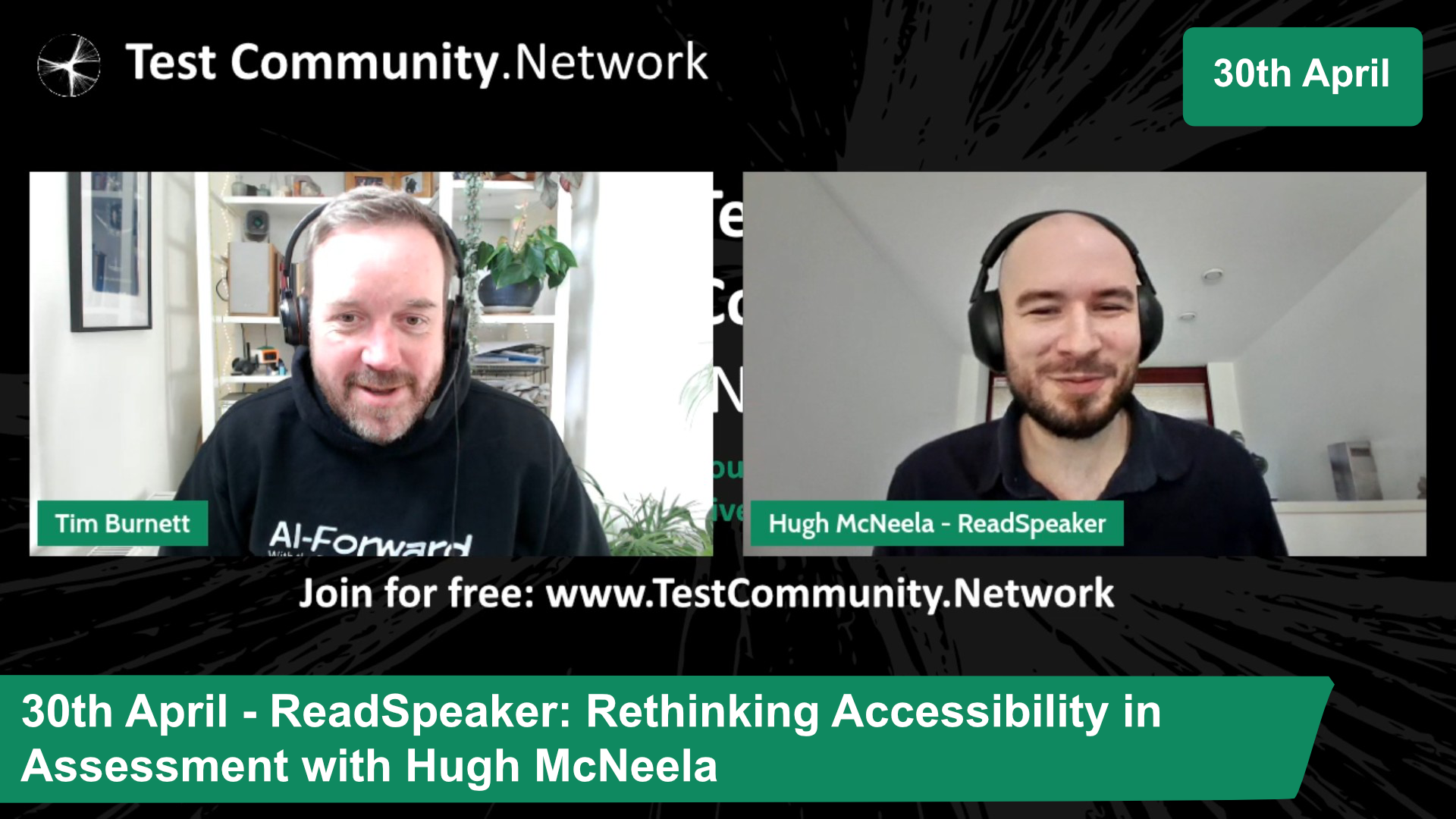
Hugh McNeela from ReadSpeaker discusses the future of inclusive assessment
Text-to-speech technology has long been associated with accessibility — a reasonable adjustment for candidates who need it. But what if the current model of "ask for help, get support" is fundamentally broken? In this episode of the Test Community Network podcast, Tim Burnett sits down with Hugh McNeela from ReadSpeaker to explore why accessibility in assessment needs to stop being the exception and start being the default.
ReadSpeaker is an enterprise-grade text-to-speech solution built specifically for digital learning platforms and high-stakes assessments. Founded 25 years ago by someone who needed it for their own use as a person with visual impairment, the company has since expanded its mission to something much broader: making voice support a standard part of how assessments are delivered, rather than a special arrangement for a minority of candidates.
"About seventy percent of people with neurodiversity challenges don't share with their employers that they have a condition."
— Hugh McNeela, Sales Account Manager – Corporate Learning, ReadSpeaker
That statistic reframes the entire conversation around accessibility support. If most people who would benefit from reasonable adjustments never come forward — due to stigma, uncertainty, or simply not having a formal diagnosis — then a system that relies on self-disclosure will always leave a significant portion of learners without the support they need. The traditional model, where a teacher sits beside a candidate and reads questions aloud, only helps those who've already navigated significant barriers to ask for it in the first place.
"By opening up Test-to-speech (TTS) across your assessments, basically what you're doing is giving universal access and reducing stigma for people."
— Hugh McNeela, Sales Account Manager – Corporate Learning, ReadSpeaker
This is the UDL (Universal Design for Learning) principle in practice. Hugh uses the analogy of dropped kerbs — designed for wheelchair users, but used every day by people with prams, suitcases, and bikes. When you build for inclusion from the start, everyone benefits. ReadSpeaker applies the same logic: rather than providing TTS as a special arrangement for a labelled few, they make it available to all candidates. The evidence backs this up — at conferences, Hugh regularly finds that 60 to 70 percent of people prefer listening over reading when given the choice.
"They found by introducing text-to-speech into their content that they were actually able to improve their thirty-day completion rates by fifty-four percent."
— Hugh McNeela, speaking about education partner Penn Foster
That result, from US-based adult learning provider Penn Foster, is striking. The organisation was struggling with text-heavy digital content — PDFs and documents uploaded to an LMS — and the reading fatigue and literacy challenges that came with it. Adding TTS was a relatively small change, but the impact on course completion was dramatic. It's a finding that Hugh believes translates directly to the UK, where Ofqual and Ofsted are placing increasing emphasis on inclusion as a built-in part of assessment design, not a bolt-on.
"It's important as an assessor that you're making sure that it's always deterministic rendering — every candidate is always going to be hearing the same pronunciation and structure."
— Hugh McNeela, Sales Account Manager – Corporate Learning, ReadSpeaker
For anyone delivering high-stakes assessments, this point matters. Consumer TTS tools and generative AI can produce inconsistent output — the same maths question read aloud differently depending on context, potentially causing real confusion for candidates mid-exam. ReadSpeaker's platform is built to be deterministic: every candidate hears the same voice, the same pronunciation, the same structure. It integrates with safe exam browsers, allows assessors to disable dictionaries, translations, copy-paste and highlighting, and includes a dedicated module for reading STEM and maths content accurately. Security and accessibility, in other words, don't have to be in tension.
The conversation is a timely one. With regulators moving towards embedding inclusion in assessment design, and with evidence that accessible delivery improves outcomes for everyone, the question for awarding organisations and training providers isn't really whether to introduce TTS — it's how quickly they can make it the default. ReadSpeaker is already integrated with a growing list of assessment platforms including Learnosity, Cirrus, Televic Education, and others, making that transition more straightforward than it might seem.
Connect with Hugh McNeela on LinkedIn: linkedin.com/in/hughmcneela
Meet Hugh and ReadSpeaker stand A60 Learning Technologies LT26UK or hear him speak on April 29th, 14.45 Theatre 4 - Accessible learning strategies - the key to empowering a neurodiverse workforce
Learn more about ReadSpeaker: readspeaker.com