Skills, Cowork and Vibe Coding: Three Shifts That Are Quietly Rewiring How We Work
Something changed around November last year, did you notice it?
Something changed around November last year, did you notice it?
If you'd been using AI to help with coding or any sort of structured work, you probably felt it — that moment when the tools stopped fighting you and started actually doing the job. Tim Burnett's latest solo episode on the Test Community Network unpacks what happened next, and more importantly, what it means for anyone working in assessment, education or qualifications right now.
The episode opens with a quick sweep of headlines — the so-called "SaaS apocalypse," open-source library hacks, Claude's new Mythos model apparently finding zero-day vulnerabilities in production code. But the real meat of the conversation is about three specific shifts that have genuinely changed what individuals and organisations can now build for themselves: skills, Cowork, and vibe coding.
"I noticed suddenly that I wasn't chasing bugs all the time. I wasn't creating bugs when I was creating a feature. It wasn't a pain in the backside like that. I was just able to build something and just add feature, feature, feature, with everything working perfectly the first time."
— Tim Burnett, Founder, Test Community Network
That tipping point matters because it opens the door to the rest of the episode. Once AI coding became genuinely reliable, the pieces above it — the workflow packaging, the agentic task-running, the no-code app building — started to make sense for ordinary users rather than just developers.
Skills are the first shift, and probably the most immediately useful for anyone doing repeatable work. A skill is a structured markdown instruction file that tells an AI exactly how to perform a task — step by step, with rules, quality gates and output formats baked in. Tim walks through his own MCQ item-generation skill, built off the back of a 58-page research sprint, which now drives a two-stage question-authoring process whenever he asks Claude to generate an item.
"A skill is a structured instruction file that tells AI exactly how to perform a task, step by step with rules, quality gates, and output formats baked in. Imagine putting this every time you did a prompt — it'd be quite a laborious process. But what you're left with is consistency."
— Tim Burnett, Founder, Test Community Network
The adoption arc Tim describes is worth paying attention to. Most people start with one-off prompting (he recommends the "five question" technique — give context, then ask the AI to ask you five questions back). From there, you graduate to projects, where you silo resources and instructions around a recurring task. And once a task becomes genuinely repeatable, you package it as a skill — portable, shareable, consistent across platforms.
Cowork is the second shift, and it takes skills a step further. Rather than the AI telling you what to do, it actually does it — reading files, moving them, creating spreadsheets, editing PowerPoints, reorganising your entire desktop if you ask it to. Tim demonstrates live by asking Claude to sort a folder of receipt photos by year, month and day, rename them with item and cost, and generate a CSV summary. It half-works in the demo (Tim's honest about the limits), but the principle is clear.
"I've had it where I had an entire knowledge base of PDFs on my computer that I'd been gathering over time, and I just said go in there and sort them all out. It went through and just reorganised everything in folders and did a brilliant job."
— Tim Burnett, Founder, Test Community Network
There's a cautionary note here, though. Cowork-style tools have full access to your machine, and there have already been high-profile incidents — an Apple executive's inbox deleted, AWS production environments wiped clean by an over-eager agent. Enterprise IT teams will have views on this, and Tim suspects Microsoft's forthcoming equivalent may struggle to land inside risk-averse organisations for exactly that reason.
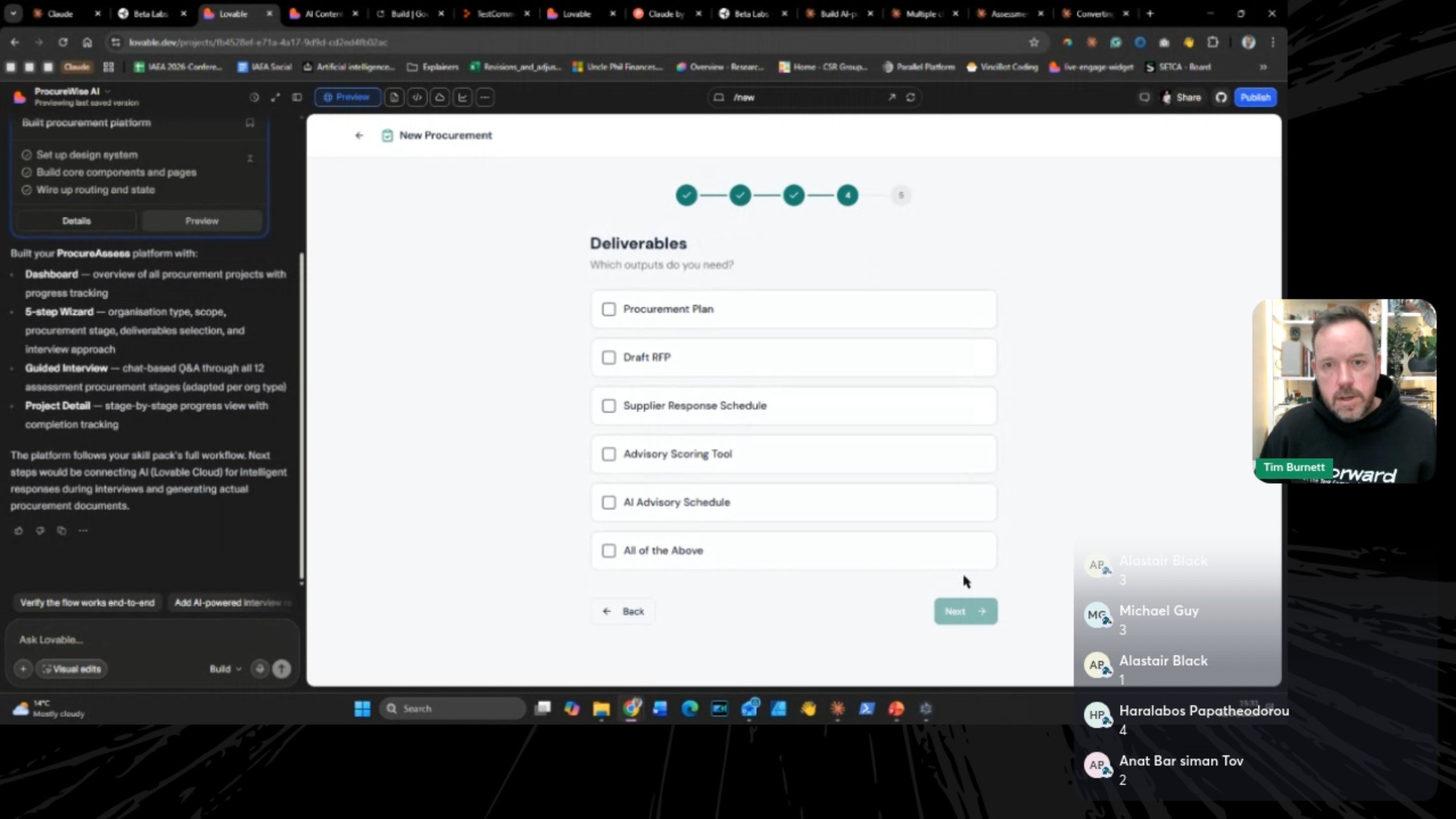
The third shift is where it all comes together. Vibe coding — the term coined by Andrej Karpathy — is the idea that you can have a natural-language conversation with an AI agent and it will build you a working application. Full stack. Database, auth, APIs, the lot. Tools like Lovable, Replit, Base44 and Google AI Studio sit at one end; IDE-based tools like Cursor and coding agents like Claude Code sit at the other.
"Within the space of me talking for about three minutes or so, I gave it a prompt, gave it a workflow that I'm using on a regular basis, and I'm now in a position where I've got an app I can work with."
— Tim Burnett, Founder, Test Community Network
Tim's strategy, and this is the bit worth writing down, is to use all three shifts in sequence. Start with chat prompting. Move to a project when the task repeats. Build a skill once the workflow is stable. And then — if it's worth scaling to a team, or if you're hitting Claude usage limits — port the skill into a vibe-coded app that runs independently, calls APIs directly, and can be shared with colleagues.
"An item bank really is just a database with a workflow sat on top. You don't necessarily need to be paying someone for that if you can set it up yourself. These vibe coding tools can potentially put you in a position where you could do that."
— Tim Burnett, Founder, Test Community Network
That's the provocation for the assessment industry specifically. Item banks, procurement workflows, marking tools, comparative judgment systems — Tim's already built working prototypes of all of these in his Beta Labs. Whether awarding organisations will actually do this themselves is another question entirely. Most will stick with trusted vendors, and for good reasons — risk appetite, IP concerns (AI-generated code currently isn't protectable as intellectual property), and the simple fact that big organisations move slowly.
But as Tim points out at the close, the threat isn't necessarily from within. It's from the smaller, AI-native organisation that spins up alongside you, builds the tools in days rather than quarters, and starts offering services at a price point the incumbents can't match. The shift from SaaS to self-built may be slower in assessment than it has been elsewhere, but it's coming. The question is whether you want to be ready for it, or surprised by it.
Connect with Tim Burnett on LinkedIn: linkedin.com/in/tburnett
Explore the Beta Labs apps: testcommunity.network → Collections → Beta Labs
Try the app! Explore the procurement platform built within 24 hrs of the webinar: procure.testcommunity.network