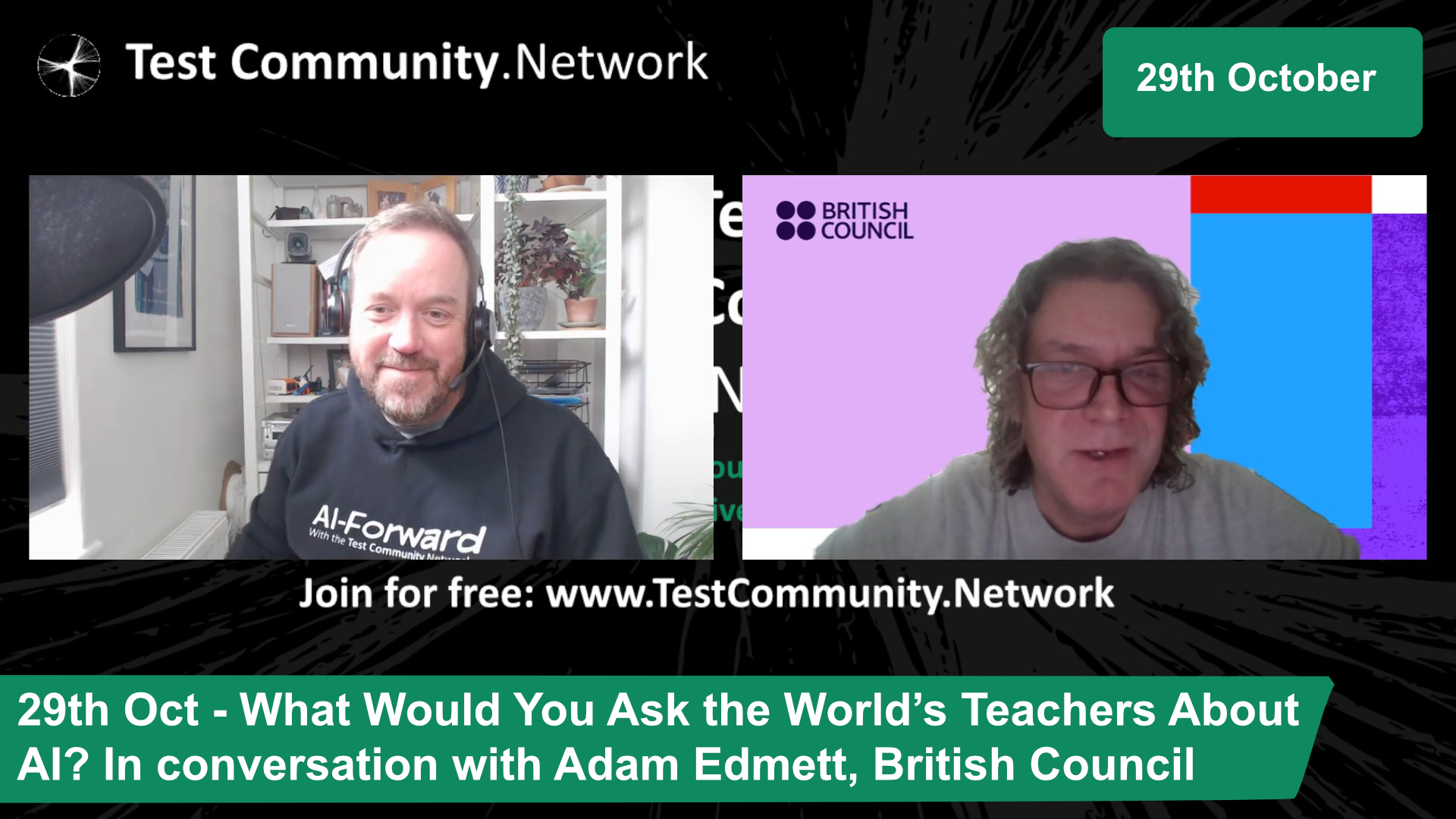
Much of the conversation about AI in education is about sweeping change: AI replacing teachers, transforming classrooms overnight, or rewriting how we assess learning. In this episode of the Test Community Network podcast, Tim Burnett speaks to someone who has seen the reality on the ground across dozens of countries, and his view is far more grounded. The real progress, he argues, is happening in small, everyday classroom practices, and the big questions are about trust, risk and who holds control.
Adam Edmett is Head of EdTech Innovation at the British Council, the UK's cultural relations organisation. His team supports technology-enabled teacher development across English and school education projects in around sixty countries. Adam has worked with the British Council for close to two decades, and has lived and worked in Qatar, Malaysia, Beijing, Tunisia, Venezuela and the Czech Republic. Recent travel has taken him to Nepal's AI for Education conference and to Turkey's national dialogue on AI. That global view shows how differently countries are approaching the technology.
"You look at China and there's far less of the doomsday scenario there. It's: we are going to use this and we're going to use it well. Whereas you might look at another country that has a lot more focus on regulation and the risks."
— Adam Edmett, Head of EdTech Innovation, British Council
Adam points to Turkey as a country that has moved quickly. It sees AI as a key driver for its education system, to the point of planning its own data centres for educational use and building tools in-house, including a conversational speaking partner and assessment tool. Many other countries are still working out the balance between formal policy and more flexible guidance. Based on recent British Council research, Adam favours a hybrid model. Firm national policy covers the non-negotiables, such as age limits on generative AI use. A network of school- and district-level guidance can then respond to rapid change.
"Quite often the risk is situated with a teacher, where there are no firm regulations behind them. The decisions they make are the ones that are impacting their students. The risk should be at that national level rather than at the teacher level."
— Adam Edmett, Head of EdTech Innovation, British Council
Data and sovereignty are also part of the picture. Adam explains that protecting children's data rightly limits what governments can do, even when they have ambitious plans for enhanced assessment. Building national capability on open-source models is partly about avoiding long-term dependency on commercial providers.
"When the big players start to really try to monetise, you would be beholden to probably a US company for a very, very large amount of money to make sure that your education system still functions, which is not a good thing."
— Adam Edmett, Head of EdTech Innovation, British Council
Adam is a firm believer in educational research, but he acknowledges that its lag behind technology has never been worse. What the sector needs, he suggests, is research into the small, specific practices where AI can genuinely help, rather than broad claims about the future of the profession.
"AI is going to replace teachers? That's just not true. It's not going to happen. But it can make very small micro practices far more efficient, and we can be sure that they're causing no harm."
— Adam Edmett, Head of EdTech Innovation, British Council
The conversation turns to feedback, one of the areas where AI is already performing strongly. Adam's concern is about what could be lost. Feedback is about trust between a teacher and a student, and about skills that teachers need to keep developing, as well as accuracy. Tim adds that new teachers who lean too heavily on AI may never build those foundation skills in the first place.
"What about the relationship between the student and the teacher, the trust? When you know that a teacher has spent that time reading the thing that you produced, commenting on it and engaging with it, compared to them just pressing a button and giving it a quick glance."
— Adam Edmett, Head of EdTech Innovation, British Council
Adam's recent visit to Nepal offered both data and inspiration. National research there found that around three-quarters of teachers had engaged with AI in some way, but fewer than one in five had received any training. There were also statistically significant gaps in uptake. Male teachers were more likely to be experimenting than female teachers, with domestic time pressures, confidence and device access all playing a part. Older teachers were less likely to be adopting AI than younger colleagues. Instead of the usual speeches, the conference set up real classrooms at the back of the hall, where teachers who had carried out classroom research taught delegates directly. In one example, a teacher used AI to generate warm-up activity ideas, discarded those that would not suit her space or her students, and then used AI translation to run a word game in a multilingual classroom where she did not speak every language.
"It seems very basic, but it transformed that part of the class for that teacher, made it more energetic and more enjoyable, and the students benefited. For me, innovation is these tiny little things, not the big, huge things that sometimes the AI companies want us to drink the Kool-Aid on."
— Adam Edmett, Head of EdTech Innovation, British Council
Adam's current focus is a major follow-up to the British Council's 2023 research on AI in English language teaching. That study combined a systematic review of ten years of AI use across every education sector, a global survey of around 1,400 teachers, and interviews with 19 key witnesses, from policymakers to teacher educators. It addressed a striking gap: teachers' voices were almost entirely absent from the existing literature. The report has since been downloaded more than 40,000 times and cited over 1,300 times. The new study will look at what has changed two to three years on, including the questions that have emerged since, and will test findings such as Nepal's gender and age gaps at a global level.
"If you had the opportunity to ask teachers about their use of AI, or anything connected to AI, what would you ask? We would be very open to hearing suggestions and then trying to integrate them into the question bank."
— Adam Edmett, Head of EdTech Innovation, British Council
This is a direct invitation to the Test Community Network. Survey questions will be finalised in November, the survey is expected to open around the end of the year, and the report is planned for launch in mid-May. Importantly, the British Council plans to publish the full dataset openly so that others can investigate and build on it.
"We plan to make the data set open. It's not something that we're going to be protecting. We're going to put it out there so other people can investigate or build on it as well."
— Adam Edmett, Head of EdTech Innovation, British Council
Looking further ahead, Adam is working with UCL on teacher–AI complementarity. The idea is that the relationship between teachers and AI should be synergistic: AI should not slowly erode skills such as giving feedback, and working with it should make teachers better at their craft. That work will involve teachers in Turkey. As Tim reflects, the timing matters. We have now had a few years of access to these tools, and the sector has a chance to learn from them before repeating the mistakes of largely unregulated social media.
Listen to the full episode to hear Adam and Tim's conversation. If you have a question you would like to put to teachers worldwide about AI, now is the time to share it. Connect with Adam on LinkedIn to contribute your ideas, and look out for the survey link so you can share it across your networks.