Paper, Pixels and Trust
Rethinking High-Stakes Exams in Pakistan with Munira Mohammad
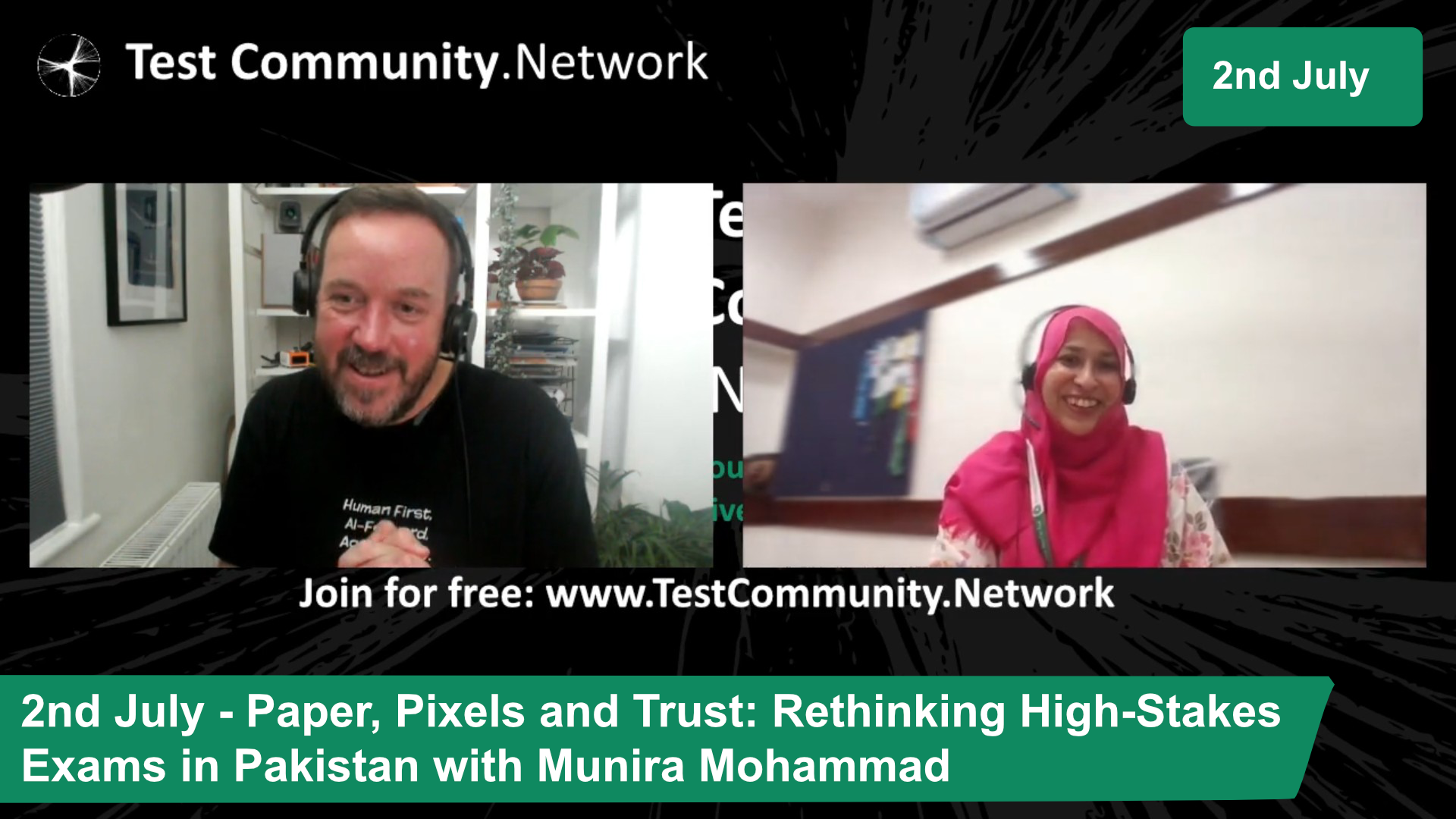
Rethinking High-Stakes Exams in Pakistan with Munira Mohammad
Across Pakistan, hundreds of thousands of students sit the same paper-pencil exam on the same day, in deserts, coastal cities, plains and mountains. Digitising all of that sounds like an obvious win. But what happens to fairness, and to trust, when you change how an exam is delivered?
In this episode, Tim Burnett sits down with Munira Mohammad, who leads a team of psychometricians, statisticians and academic experts at the Aga Khan University Examination Board (AKU-EB) — Pakistan's first private national board for secondary and higher secondary certificates, established in 2002. Munira is also an IAEA ambassador, and the two will meet in person at the association's conference in Toronto this September.
She walks through a system built around transparency: schools affiliate and receive syllabi, pacing guides and model papers; teachers are trained before they ever enter the classroom; MCQs are scanned via OMR while descriptive answers are e-marked centrally in Karachi by affiliated teachers. Every cycle closes with a personalised school performance report — right down to which student learning outcome each question tested and how the school performed against the nation. One detail stands out:
"Because we do not work on relative marking — we work on absolute marking. So if there are any errors found in the assessment tool, the students are not penalised and are awarded the marks."
— Munira Mohammad, Aga Khan University Examination Board
It's this culture of fairness that frames Munira's caution about digital transformation. The upside is clear: efficiency, speed, and tighter control over the leakage of exam papers, which in Pakistan is as much a political problem as a logistical one. But the moment you change the modality, you risk changing the thing you're trying to measure.
"For me, assessment is about your capabilities. If your typing speed is not that fast, it should not impact your ability in the subject, or your knowing of that subject."
— Munira Mohammad, Aga Khan University Examination Board
Tim points out that these challenges are far from unique to Pakistan. England's regulator, Ofqual, treats a digitised exam and its paper equivalent as two separate qualifications to be balanced independently — precisely because the "digital native" assumption breaks down on contact with reality. Students may be fluent on a phone, but a laptop exam is another matter entirely, and not only for language: as Munira notes, subjects like mathematics draw on motor skills too. With unstable electricity and patchy internet still a fact of life even in big cities, a full switch from paper is simply not on the table. Both agree the more interesting question isn't how to digitise the existing exam, but whether to rethink it altogether — towards adaptive, on-demand assessment that gives students feedback for an ongoing learning journey rather than a single pass-or-fail verdict.
Whatever the modality, Munira is clear about the non-negotiable:
"At the end of the day, the qualification that the student gets has to have that trust. If that trust is not maintained, then the modality is of no use."
— Munira Mohammad, Aga Khan University Examination Board
This is where the conference comes in. Munira describes the real value of gathering with practitioners from around the world as the discovery that the so-called global North and South are wrestling with the very same problems.
"By default, we are addressing the same set of humans, irrespective of whether they are in the north or the south. So the problems, the difficulties, the challenges are the same."
— Munira Mohammad, Aga Khan University Examination Board
Tim likens it to jumping onto a fast-moving train — only to find the people who inspired you are already jumping off, having realised the approach had flaws. He cites recent OECD research (discussed on a previous episode with Rebecca Frankum and Lena Gray) which found that continuous assessment, attractive in theory, can become an unmanageable burden in practice. Munira's instinct is to keep asking the harder question rather than chase the trend:
"There are countries now restricting their students' use of technology to a certain age. So are we getting onto a bandwagon that is going to shift in the next five years? Or are we doing the right thing and we should continue on?"
— Munira Mohammad, Aga Khan University Examination Board
In Toronto, Munira will present two abstracts — one on AKU-EB's school performance reports and the trust they build, another on predicting item difficulty using a modified Angoff method and tracking how those predictions shift from internal experts to classroom teachers. Tim, meanwhile, is keen to grab a laptop and use AI to prototype an end-to-end assessment experience there and then. Five minutes of conversation now, he reckons, means they can pick up at fifty when they meet. Listen to the full episode for a grounded, thoughtful look at what digital transformation really demands of a high-stakes exam system.
Connect with Munira Mohammad on LinkedIn: linkedin.com/in/munira-mohammad-64879190
Connect with Tim Burnett on LinkedIn: linkedin.com/in/tburnett